Navigating Turkey’s Dynamic Property Market in 2026
The Turkish property landscape has transformed into one of the Mediterranean and Eurasian basin’s most resilient, lucrative, and strategic asset classes. As cross-border capital flows realign toward tangible wealth preservation and inflation-hedged yields, identifying the best real estate investment projects in Turkey requires an analytical, multi-layered approach. Turkey stands uniquely positioned at the crossroads of European regulatory standards, Middle Eastern commercial influence, and Central Asian trade logistics. Backed by monumental infrastructure upgrades, modernized property registries, and a robust legal architecture for international buyers, the country delivers unprecedented opportunities across residential, commercial, and mixed-use sectors.
Whether institutional funds are deploying capital into transit-oriented urban complexes or private family offices are acquiring prime sea-view properties to secure long-term capital growth and residency, Turkey’s market provides exceptional diversity. This comprehensive analysis evaluates top-tier developments across Istanbul, the Turkish Riviera, and emerging provincial powerhouses. Through rigorous evaluations of financial performance, structural build quality, municipal master planning, and capital exit strategies, this guide equips discerning investors with the verified insights needed to make calculated, high-return property acquisitions in 2026.
Macroeconomic Catalysts Fueling Real Estate Projects in Turkey
Understanding the value trajectory of premier developments requires examining the structural fundamentals underpinning Turkey’s property sector. Real estate is not merely a residential necessity in Turkey; it functions as an institutional-grade hedge against currency fluctuations, sustained domestic inflationary cycles, and global asset volatility.
1. Megaproject Infrastructure and Transit-Oriented Growth
Infrastructure development in Turkey operates at a scale rivaled by few global economies. Over the past decade, high-speed rail lines (YHT), expanded deep-water maritime ports, and the ongoing modernization of municipal metro systems have systematically redefined land valuations. In Istanbul, the full integration of the M11 metro line linking Istanbul Airport directly to financial hubs like Kağıthane and Gayrettepe has compressed travel times, turning previously peripheral zones into prime mixed-use development corridors. Transit connectivity drives tenant retention, reduces vacancy rates, and elevates capital gains across peripheral master communities.
2. Sustained International Investor Demand and the Citizenship Inflow
Foreign direct investment (FDI) into Turkish real estate remains fueled by clear statutory mechanisms. Foreign nationals investing in qualifying residential or commercial units can access accelerated naturalization pathways. When navigating these opportunities, consulting our definitive roadmap on the Turkish Citizenship by Property 2026: Full Guide ensures full compliance with statutory valuations, banking transfer protocols, and mandatory holding covenants.
3. Demographics, Household Formation, and Urban Regeneration
Turkey possesses one of Europe’s youngest median demographics, with a median age under 34. This demographic engine fuels constant household formation, driving internal demand for modern, earthquake-resistant residential developments. Government mandates around Kentsel Dönüşüm (Urban Transformation) prioritize replacing older building stock with modern structural complexes built to post-2018 anti-seismic standards. Projects built under these strict guidelines command substantial market premiums in both rental yields and secondary market resales.
Get a free consultation now, and let us help you choose the right property.
Core Profiles: What Defines the Best Investment Projects?
Not every newly launched residential complex offers investment-grade viability. Seasoned real estate analysts segment the best real estate investment projects in Turkey into four distinct categories, each aligning with specific portfolio objectives, liquidity preferences, and risk tolerances.
Master-Planned Mixed-Use Developments
These massive “city-within-a-city” projects integrate residential high-rises, Grade-A commercial office suites, open-air pedestrian retail boulevards, educational institutions, and healthcare clinics. Their comprehensive nature insulates them from localized micro-market downturns by establishing an independent, self-sustaining ecosystem. They consistently attract multinational corporate executives, diplomatic personnel, and affluent families who prioritize convenience and high-spec security.
Waterfront and Coastal Branded Residences
Positioned along the Bosphorus strait, the Marmara coastal highway, or the Aegean and Mediterranean shorelines (such as Bodrum, Fethiye, and Antalya), waterfront projects offer irreplaceable real estate. Because waterfront zoning permissions are tightly restricted, these developments retain scarcity value, shielding investor capital and yielding prime euro- and dollar-pegged short-term rental revenue streams.
Transit-Adjacent Urban Core Regeneration Projects
Centrally located projects emerging from strategic land assemblies in established business districts provide steady annual yields and reliable rental liquidity. These properties appeal directly to upwardly mobile domestic professionals, corporate long-term tenants, and international consultants operating in Turkey’s key financial hubs.
Branded Hotel Apartments & Serviced Hospitality Suites
Institutional operators managing international hotel flags (such as Marriott, Accor, or Radisson) partner with Turkish master developers to sell fractional or full deed title units. These hospitality assets generate hands-free, pooled rental yields distributed in hard currencies, removing everyday tenant management burdens from overseas investors.
Istanbul’s Flagship Investment Corridors and Landmark Projects
Istanbul remains the undisputed locomotive of Turkey’s real estate market, capturing the largest share of national property transactions and foreign investment capital. The city’s multi-centric development presents distinct investment sub-markets across its European and Asian sectors. To explore broader territorial performance, consult our curated breakdown of the Best Areas for Real Estate Investment in Istanbul.
The Basın Ekspres & Media Highway Business Axis
Formally designated by the Istanbul Metropolitan Municipality as a premier Central Business District (CBD) expansion zone, the Basın Ekspres corridor connects the E-5 and TEM highways directly to the northern airport corridor. Projects in this corridor are characterized by modern high-rise architecture, integrated commercial shopping arcades, and flexible home-office layouts.
- Investment Profile: Optimal for high-yield corporate rentals, international business trade hubs, and long-term capital appreciation.
- Target Demographics: Logistics specialists, financial services personnel, software engineers, and international business travelers.
- Average Rental Yields: 6.5% to 8.2% annually, supported by corporate leasing structures.
Maslak, Seyrantepe, and the Vadi Istanbul Enclave
Nestled adjacent to the Belgrad Forest along the Cendere Valley, the Vadi Istanbul and Seyrantepe corridor represents modern corporate Istanbul. Known for corporate headquarters, luxury residential towers, and upscale outdoor lifestyle centers, projects here reflect high prestige and liquidity.
- Asset Type: Ultra-luxury residences, institutional-grade commercial towers, and penthouses.
- Performance Metric: Moderate gross yields (4.5% to 6%) coupled with some of the highest secondary-market capital appreciation rates in southeastern Europe.
- Liquidity Horizon: Exceptional; resales in this district consistently attract high-net-worth Turkish and international buyers alike.
Zeytinburnu & Bakırköy Coast: Sea-Facing Luxury High-Rises
Directly fronting the Sea of Marmara along the Kennedy Avenue coastal highway, this strip features striking modern architecture. High-rises here offer unobstructed sea vistas, wide smart-home layouts, and comprehensive lifestyle amenities just minutes from Istanbul’s historic peninsula.
- Investment Profile: Wealth preservation, citizenship-qualifying luxury asset holdings, and premier lifestyle usage.
- Construction Quality: Built with advanced marine-grade concrete, specialized anti-corrosive facade systems, and foundational engineering down to deep bedrock layers.
Kadıköy & Fikirtepe: The Asian Side’s Regeneration Success
On Istanbul’s Anatolian shore, the state-supported urban transformation of Fikirtepe has matured into a skyline of contemporary, interconnected residential blocks. Supported by the Ministry of Environment, Urbanization and Climate Change, these projects eliminate construction delivery risk while offering access to the bustling cultural lifestyle of Kadıköy and the Marmaray transit network.
Coastal Powerhouses: Antalya, Bodrum, and İzmir
While Istanbul dominates institutional corporate investment, Turkey’s coastal markets have evolved beyond simple summer holiday homes into permanent luxury and investment hubs. Driven by remote corporate executives, digital entrepreneurs, and international retirees, developments in these regions yield strong returns via seasonal and mid-term rentals.
Antalya: Mediterranean Yields and Year-Round Tourism
Antalya represents one of the Mediterranean’s most dynamic hospitality and residential markets. Supported by an international airport with year-round intercontinental connectivity, districts like Konyaaltı, Lara, and Altıntaş have seen substantial construction investment.
- Altıntaş Development Zone: Situated adjacent to Antalya Airport, Altıntaş has become the city’s premier planned development zone. Projects here feature resort-style layouts, extensive swimming complexes, shuttle services to private beaches, and smart-home infrastructure.
- Rental Dynamics: The city’s extended 10-month tourist season, combined with expanding medical tourism hubs, allows investors to achieve attractive yields through managed short-term rental arrangements.
Bodrum Peninsula: The Ultra-Luxury Branded Haven
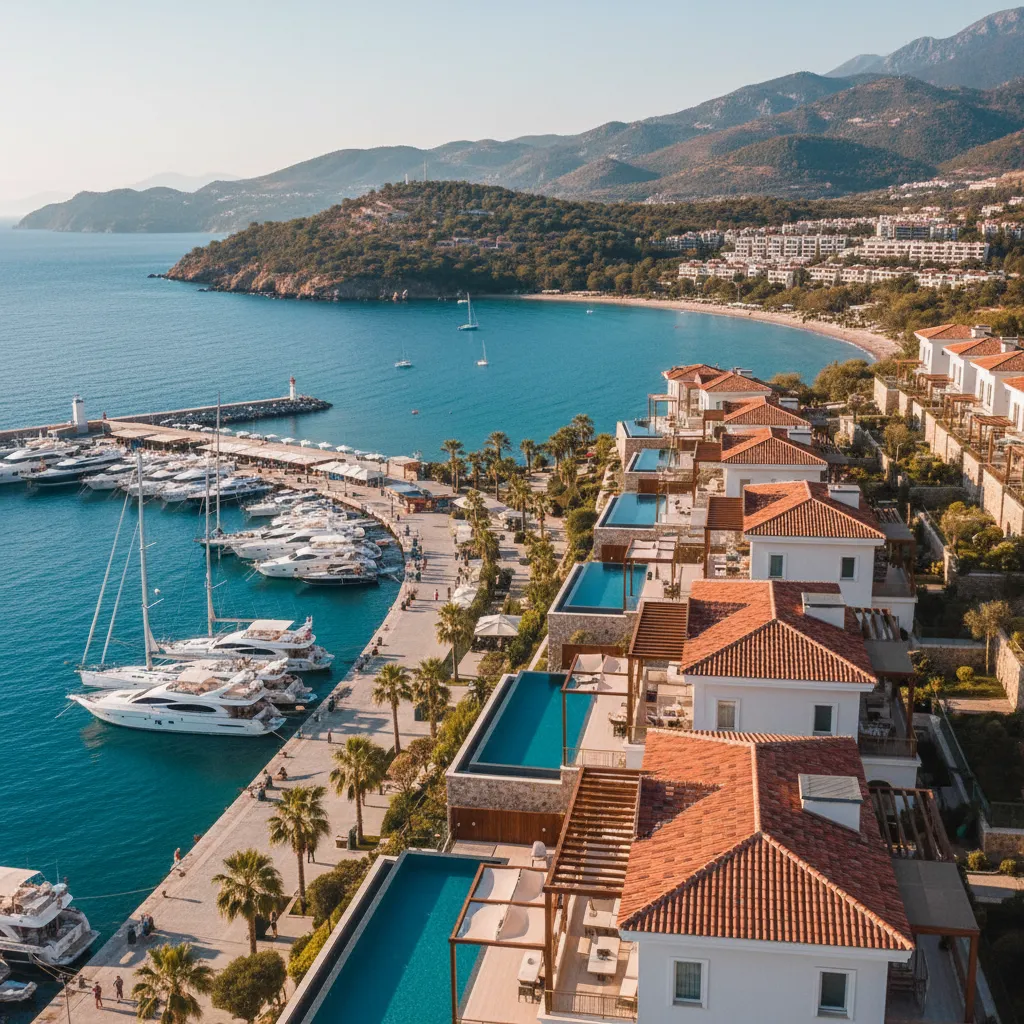
Bodrum has evolved into an elite global yachting and lifestyle destination, often referred to as the St. Tropez of the Eastern Mediterranean. Developments in Yalıkavak, Türkbükü, and Gümüşlük are characterized by low-rise stone architecture, private jetties, infinity pools, and partnerships with leading luxury hospitality brands (e.g., Mandarin Oriental, Aman, Edition).
- Yield Profile: Lower baseline annual yields (3.5% to 5%) offset by exceptionally high summer weekly rates ($10,000 to $40,000+ per week for luxury detached villas during peak months).
- Asset Security: Exceptional scarcity; stringent zoning laws prohibit high-density construction, protecting property values from supply dilution.
İzmir: The Aegean’s Commercial and Cultural Capital
For investors seeking balanced residential growth, İzmir offers a cosmopolitan alternative. The Bayraklı district serves as the city’s modern financial center, where commercial high-rises and residential towers overlook the Gulf of İzmir. Alsancak and Bornova feature targeted urban-infill projects offering consistent domestic tenancy demand.
Get a free consultation now, and let us help you choose the right property.
Comparative Performance Matrix: Top Investment Project Typologies
To evaluate potential capital allocations across the best real estate investment projects in Turkey, review this cross-sectional performance comparison of current project archetypes:
| Project Archetype | Primary Locations | Projected Net Yield | Capital Upside | Target Tenant Profile |
|---|---|---|---|---|
| Master Mixed-Use Megaprojects | Basın Ekspres, Başakşehir, Kağıthane | 6.5% – 8.0% | High (5-year cycle) | Corporate expats, domestic families, tech workforce |
| Prime Seafront Luxury Complexes | Zeytinburnu, Bakırköy, Üsküdar | 4.0% – 5.5% | High (Scarcity driven) | HNWIs, regional elites, diplomatic corps |
| Branded Resort & Marina Villas | Bodrum, Göcek, Kalkan | 7.0% – 9.5% (Seasonal) | Moderate – High | International vacationers, high-end seasonal tenants |
| Serviced Hotel Apartments | Şişli, Taksim, Maslak | 7.0% – 8.5% (Pooled) | Moderate | Short-stay business travelers, medical tourists |
| Urban Regeneration High-Rises | Kadıköy, Kartal, Maltepe | 5.5% – 7.0% | Very High (Off-plan entry) | Local professionals, young dual-income couples |
Legal Due Diligence: Securing Your Real Estate Acquisition
Acquiring real estate in Turkey is a transparent, legally codified procedure under the Turkish Civil Code and Land Registry Law No. 2644. However, foreign capital deployments require thorough verification across multiple statutory touchpoints to protect investment equity and avoid structural delays.
Title Deed (Tapu) Verification and Encumbrance Audits
The Land Registry Directorate (Tapu ve Kadastro Genel Müdürlüğü) issues ownership deeds. Before transferring reservation funds, your legal counsel must perform an exhaustive registry search to confirm that the property title is free of any:
- İpotek (Mortgages): Previous developer financing claims registered on the title.
- Haciz (Liens/Seizures): Tax authority claims or outstanding court litigation orders.
- Şufa Hakları (Pre-emption rights): Third-party purchase options on underlying land shares.
Investors can review a broad portfolio of fully vetted, legally verified opportunities via our direct directory of Real Estate Investment in Turkey | Apartments and Villas for Sale, where each project undergoes strict legal screening before listing.
Government Partnerships: Emlak Konut & TOKİ Assurances
One of the safest ways to enter Turkish real estate off-plan is through revenue-sharing projects backed by Emlak Konut GYO (the real estate investment arm of the Turkish government) or TOKİ (Housing Development Administration). Under these arrangements, the public entity guarantees project delivery according to state architectural specifications, virtually eliminating non-completion risk.
Mandatory Valuation Reports (Ekspertiz) & Currency Exchange (DAB)
Turkish regulations require an independent valuation report from a Capital Markets Board (SPK)-licensed firm for all property transactions involving foreign buyers. This report confirms the fair market value of the unit, safeguarding against artificial price inflation.
Foreign buyers must also convert their foreign currency (USD, EUR, GBP) into Turkish Lira through the Central Bank of Turkey (TCMB), which issues a Foreign Exchange Purchase Certificate (Döviz Alım Belgesi or DAB). This certificate serves as the official financial receipt registered at the Land Registry to confirm clear transactional funds.
Rental Yield Maximization: Operational Models
Maximizing returns on Turkish property assets requires choosing the right leasing structure and operating model for your target market.
1. The Managed Long-Term Leasehold Model
Traditional 1-year renewable residential leases governed by the Turkish Code of Obligations provide stable, low-maintenance income. While historical rent caps have evolved, securing corporate leases paid semi-annually or annually in advance remains an effective strategy to mitigate currency fluctuations and maintain steady operational yields.
2. The Short-Term Tourist Rental Model (Post-2024 Regulatory Framework)
Legislation governing short-term holiday rentals (properties leased for under 100 days) requires operators to secure a permit from the Ministry of Culture and Tourism. Crucially, obtaining this permit requires unanimous consent from all property owners within an apartment building, unless the project is classified as a “High-Quality Residential Complex” (Residans) with on-site management services, reception, and mixed-use commercial licensing.
When targeting short-term tourism income, investors should focus on developments with registered Residans status to maintain seamless compliance with Ministry short-let licensing standards.
3. The Fully Managed Hotel Suite Model
For passive investors, branded hotel residences offer operational simplicity. Under this structure, the on-site hotel operator manages marketing, housekeeping, concierge services, and guest check-ins, distributing quarterly or bi-annual net dividends to deed holders based on pooled operational occupancy.
Financial Blueprint: Two Investment Case Studies
To illustrate how returns are realized across different project typologies, consider two representative investment scenarios based on prevailing 2026 transaction parameters.
Case Study A: Off-Plan High-Rise in a Central Istanbul Regeneration Zone
- Acquisition Price (Off-Plan): $280,000
- Target Completion Window: 24 months
- Payment Terms: 50% down payment, 24 monthly interest-free installments
- Market Value at Delivery: $375,000 (33.9% nominal capital appreciation based on stage-of-construction revaluations)
- Long-Term Rental Yield: $2,000 per month ($24,000 annually)
- Gross Rental Yield Post-Completion: 6.4% on finished asset value (8.57% on initial capital outlay)
- Investment Profile: Strong capital growth driven by off-plan equity realization, paired with healthy long-term leasing yields.
Case Study B: Prime Bodrum Branded Marina Villa
- Acquisition Price (Completed): $1,250,000
- Ownership Model: Freehold title with private garden, pool, and marina mooring rights
- Citizenship Eligibility: Exceeds statutory minimum thresholds; full family eligibility
- Operational Model: 16-week high-season luxury holiday rental / owner occupancy off-season
- Seasonal Gross Revenue: $110,000 (average $6,875 net weekly take-home across prime summer dates)
- Operational Overhead (Management/Pool/Security): $22,000 annually
- Net Annual Rental Yield: 7.04% (denominated in EUR/USD equivalents)
- Investment Profile: Premium lifestyle usage combined with hard-currency seasonal revenue.
Due Diligence Checklist: 7 Essential Verification Steps
Before executing binding contracts or sending earnest money deposits for Turkish real estate, ensure your transaction team completes these core checks:
-
- Verify the Developer’s Track Record: Review past completed projects, balance-sheet strength, and whether the developer holds debt exposure to insolvent lending syndicates.
- Confirm Property Registry Status (Kat İrtifakı vs. Kat Mülkiyeti): Ensure the property has transition-ready construction servitude (Kat İrtifakı) or finalized independent unit ownership (Kat Mülkiyeti) with an İskan (Habitation Certificate).
- Inspect Construction Quality Specifications: Review architectural annexes for seismic design parameters, insulation ratings, mechanical systems, and soundproofing standards.
- Audit Common Area Obligations (Aidat): Confirm projected monthly maintenance dues (Aidat) to evaluate their impact on net rental yields.
- Review Exit Liquidity and Resale Restrictions: If pursuing citizenship, ensure you understand the mandatory 3-year title lock covenant and assess local market depth for your target exit timeline.
- Confirm Infrastructure Timelines: For emerging suburban nodes, verify municipal transit plans directly with the local municipality rather than relying solely on marketing collateral.
- Secure Bilingual Legal Counsel: Work with an independent, BAR-registered Turkish real estate attorney who represents your interests exclusively throughout contract drafting and deed conveyance.
Future Trends: Turkish Real Estate Through 2030
Looking toward the end of the decade, several trends will shape the long-term value of Turkish property investments:
Green Building Certifications (LEED and BREEAM)
As institutional funds face stricter ESG mandates, developments featuring gold or platinum LEED certifications, greywater recycling systems, and solar arrays are commanding premium rental rates from multinational corporate tenants.
Integrated Technology Infrastructure
Smart-home automation, keyless IoT access, EV charging infrastructure, and on-site fiber nodes have shifted from luxury upgrades to standard investor expectations, directly influencing secondary-market pricing power.
Decentralized Commercial and Residential Hubs
With hybrid work models firmly established, self-contained satellite sub-centers featuring robust transit links, dedicated co-working facilities, and walkability scores above 85 are consistently outperforming isolated, car-dependent developments.
Frequently Asked Questions (FAQ)
Can foreign buyers own 100% freehold title deeds in Turkey?
Yes. Turkey operates under a secure freehold title system. Foreign nationals purchasing property receive outright freehold ownership (Mülkiyet), granting complete ownership rights over the real estate and its underlying pro-rata land share. These deeds are registered at official government Land Registry directorates and can be transferred, mortgaged, or passed down to heirs according to standard probate law.
What are the total closing costs when purchasing property in Turkey?
Closing costs in Turkey are relatively modest compared to many European markets. Buyers should budget between 6% and 8% of the property purchase price to cover all acquisition expenses, which include:
- Title Deed Transfer Tax (Tapu Harcı): 4% of the declared property valuation (statutorily split 2% / 2% between buyer and seller, though contracts often assign this fully to the purchaser).
- Independent Valuation Fee (Ekspertiz): Typically $300 to $600.
- Legal Counsel Fees: Generally 1% to 1.5% of transaction value.
- Land Registry Administration & Translation Fees: Approximately $400 to $800.
- Value Added Tax (KDV): Ranges from 1