
Turkey’s Citizenship by Investment (CBI) program continues to stand as one of the world’s most accessible, resilient, and strategically valuable migration routes. Established under statutory provisions designed to attract foreign direct investment, the real estate acquisition pathway allows international buyers to secure full citizenship, permanent residency, and a powerful passport for their immediate families. As we navigate the regulatory environment in 2026, prospective investors must navigate strict valuation standards, foreign exchange conversion protocols, and cadastral due diligence to successfully complete the naturalization process.
While the core financial benchmark remains anchored at $400,000 USD, administrative oversight has become increasingly rigorous. The Turkish Land Registry and Cadastre Directorate (TKGM), in coordination with the Directorate General of Migration Management (GÖÇ İdaresi) and the Central Bank of the Republic of Turkey (TCMB), enforces zero-tolerance compliance standards. For a complete tactical overview of the legal framework, consult our detailed Turkish Citizenship by Property: 2026 Guide to understand how administrative updates impact your entry strategy.
The Legal Framework of Turkish Citizenship by Investment
The foundational basis for acquiring Turkish citizenship through real estate investment is codified in the Turkish Citizenship Law (Law No. 5901) and its corresponding Implementing Regulation, specifically Article 20. Originally introduced with an entry threshold of $1,000,000 in 2017, the Turkish government progressively recalibrated the financial requirement to $250,000 in 2018 before raising it to the current statutory minimum of $400,000 in June 2022. In 2026, this threshold remains unchanged, though enforcement procedures surrounding transaction integrity have reached unprecedented levels of scrutiny.
Key Regulatory Updates Governing 2026 Applications
Investors entering the market in 2026 face an administrative landscape refined by several circulars aimed at eliminating speculative valuations, circular property transfers, and artificial currency transactions:
- Rigid Foreign Exchange Conversion (DAB Mandatory Execution): Under TCMB guidelines, foreign funds must be transferred in foreign currency (USD, EUR, GBP, etc.) and converted to Turkish Lira exclusively via an authorized Turkish retail bank, which in turn exchanges the currency with the Central Bank to generate a Döviz Alım Belgesi (DAB – Foreign Exchange Purchase Certificate).
- Real Estate Valuation Oversight: Every property transaction intended for citizenship must undergo an independent appraisal by an appraisal company authorized by the Capital Markets Board of Turkey (SPK). Since the integration of automated land registry valuation algorithms, declared values on the deed must precisely harmonize with the SPK valuation.
- Strict Deed Eligibility (The “One-Time” Rule): A single property cannot be utilized multiple times across different foreign investors to qualify for citizenship. If a property was previously purchased by a foreign national who utilized it to obtain Turkish citizenship, that property is permanently barred from being reused for citizenship by another foreign investor.
- Direct Developer/Seller Lineage: Properties purchased from foreign entities or foreign individuals do not qualify. The real estate must be acquired directly from a Turkish citizen or an incorporated Turkish company devoid of direct foreign shareholder dominance intended to bypass legal restrictions.
Core Financial and Property Requirements for 2026
Meeting the statutory requirements involves far more than simply wiring $400,000 to Turkey. The entire acquisition architecture must align with legal parameters governing property types, ownership structures, and minimum financial thresholds.
The $400,000 USD Financial Threshold
The baseline financial benchmark is calculated strictly in foreign currency equivalents, pegged primarily against the US Dollar based on the official TCMB exchange rate established on the exact date the DAB is issued. The transaction must equal or exceed $400,000 USD. If an investor purchases a property priced in Turkish Lira, the foreign currency equivalent deposited and converted via the DAB at that specific timestamp dictates statutory eligibility.
It is strongly recommended that international investors build a 3% to 5% financial buffer over the $400,000 minimum. Minor intra-day currency fluctuations between the initial wire transfer, the execution of the DAB, and the final registration at the Land Registry (Tapu Dairesi) can potentially drop the calculated figure below the legal threshold, causing the application to be rejected.
Eligible Property Categories
The Turkish real estate framework offers significant flexibility regarding the types of property that qualify for citizenship, provided they possess clear legal status:
- Residential Real Estate: Apartments, villas, duplexes, and branded residences possessing either full ownership title (Kat Mülkiyeti) or construction servitude title (Kat İrtifakı).
- Commercial Real Estate: Office suites, retail shops, warehouses, hotels, and logistics facilities. Commercial units are especially attractive for passive investors seeking predictable rental yields denominated in commercial lease contracts.
- Bare Land and Plots (Arsa): Undeveloped plots are eligible, provided that a concrete architectural project (approved by the relevant municipality) is formally submitted to the Ministry of Environment, Urbanization and Climate Change within two years of acquisition.
Single vs. Multiple Property Portfolios
Under current 2026 regulations, investors can achieve the $400,000 threshold either through a single high-value unit or by aggregating multiple properties. However, critical restrictions apply:
- If multiple properties are purchased, all properties must be presented simultaneously or within an interconnected transaction timeline to obtain a single, consolidated Certificate of Conformity (Uygunluk Belgesi).
- When buying off-plan properties using a preliminary sales contract executed before a notary public (Noter Satış Vaadi Sözleşmesi), all units must ideally be bound within a single unified contract if they are to be combined toward the $400,000 threshold.

Get a free consultation now, and let us help you choose the right property.
The Mechanics of Currency Exchange: The DAB (Döviz Alım Belgesi)
The creation and execution of the Foreign Exchange Purchase Certificate (DAB) is arguably the most sensitive technical hurdle within the entire naturalization workflow. Any error in the issuance, wording, or fund transmission will paralyze the Land Registry transfer.
How the DAB Transaction Works
Foreign buyers cannot pay the seller directly in foreign currency or hand over physical cash. The transaction flow operates under a strict four-step mechanism:
-
- The investor transfers foreign currency (USD, EUR, GBP, CHF) from their overseas bank account directly into their own personal bank account at an authorized Turkish bank (e.g., Ziraat, İşbank, Garanti BBVA, Vakıfbank). In select cases, the transfer may proceed directly to the seller’s Turkish bank, though routing through the buyer’s own Turkish account provides superior transparency.
- The Turkish intermediary bank sells the designated foreign currency to the Central Bank of Turkey (TCMB) at the prevailing institutional rate.
- The Central Bank issues the digital DAB, which contains the investor’s full legal name, passport number, foreign tax identity number, the exact foreign currency amount liquidated, and the corresponding Turkish Lira proceeds.
- The Turkish bank then transfers the generated Turkish Lira proceeds directly to the seller’s verified domestic bank account with specific payment annotations citing citizenship acquisition under Law No. 5901.
To explore how capital deployment strategies intersect with institutional real estate selections, examine our deep dive into the Turkish Citizenship for Investors: Property Guide.
Step-by-Step Acquisition and Naturalization Roadmap for 2026
The journey from selecting a property to taking the oath of allegiance and collecting Turkish passports spans multiple governmental departments. Below is the operational sequence required to complete the procedure smoothly.
Phase 1: Legal Due Diligence and Property Selection
Before issuing down payments or signing reservation agreements, an investor’s legal counsel must conduct comprehensive due diligence at the relevant Title Deed Directorate. The property must be thoroughly audited for liens (haciz), bank mortgages (ipotek), foreclosure proceedings, or municipal clearance infractions. Identifying high-growth micro-markets is paramount during this stage; investors frequently evaluate strategic master-planned projects across top districts detailed in our breakdown of the Best Areas for Real Estate Investment in Istanbul.
Phase 2: SPK Valuation Report
An official valuation must be ordered via the Land Registry’s centralized automated assignment platform (TADEBISS), which prevents developers from hand-picking appraisal firms. The assigned SPK-accredited appraiser assesses physical condition, municipal permits (iskan), zoning status, and market comparables. The finalized report’s Turkish Lira valuation must meet or exceed the equivalent of $400,000 USD on the date of appraisal.
Phase 3: Execution of the DAB and Bank Transfers
Once the valuation report confirms compliance, the investor converts their capital via the Turkish banking system to generate the formal DAB. The bank releases the funds to the seller, securing an unalterable receipt (dekont) carrying official digital and wet bank stamps.
Phase 4: Title Deed Transfer (Tapu) and 3-Year Resale Restriction
The parties meet at the Land Registry Directorate. A formal restriction (şerh) is placed directly on the title deed register pursuant to Article 20 of the Regulation on the Implementation of the Turkish Citizenship Law. This statutory annotation states: “The owner commits not to sell this property for three (3) years from the date of acquisition for the purpose of acquiring Turkish citizenship.”
Phase 5: Obtaining the Certificate of Conformity (Uygunluk Belgesi)
Upon registration of the title deed and annotation, the Land Registry forwards the file to the General Directorate of Land Registry and Cadastre Foreign Affairs Department. After auditing the SPK valuation, the DAB, the bank receipts, and the deed records, the department issues the official Certificate of Conformity, certifying the financial validity of the investment.
Phase 6: Investor Residence Permit Application (Article 31/j)
With the Certificate of Conformity in hand, the main applicant applies for a specialized short-term residence permit under Article 31, Paragraph (j) of Law No. 6458 on Foreigners and International Protection. This unique residence card is reserved exclusively for primary investors and does not require conventional residency minimums or prolonged physical presence in the country.
Phase 7: Citizenship Dossier Submission and Security Vetting
The investor submits the full naturalization dossier to the Special Joint Bureau for Citizenship (operating under the Directorate General of Civil Registration and Citizenship Affairs). The application undergoes rigorous multi-agency national security checks conducted by the Turkish National Police (Emniyet), the Ministry of Interior, and the National Intelligence Organization (MİT). These agencies verify that the applicant and their dependants pose no threat to national security or public order.
Phase 8: Presidential Approval, Biometrics, and Passport Issuance
Upon positive conclusion of security vetting, the application file is batched and forwarded to the Presidency of the Republic of Turkey. The President grants final naturalization approval. Once signed, the investor and eligible family members visit a local civil registration office in Turkey or a Turkish Embassy/Consulate abroad to register biometrics, capture fingerprints, and receive their national identity cards (Kimlik Kartı) and Turkish biometric passports.
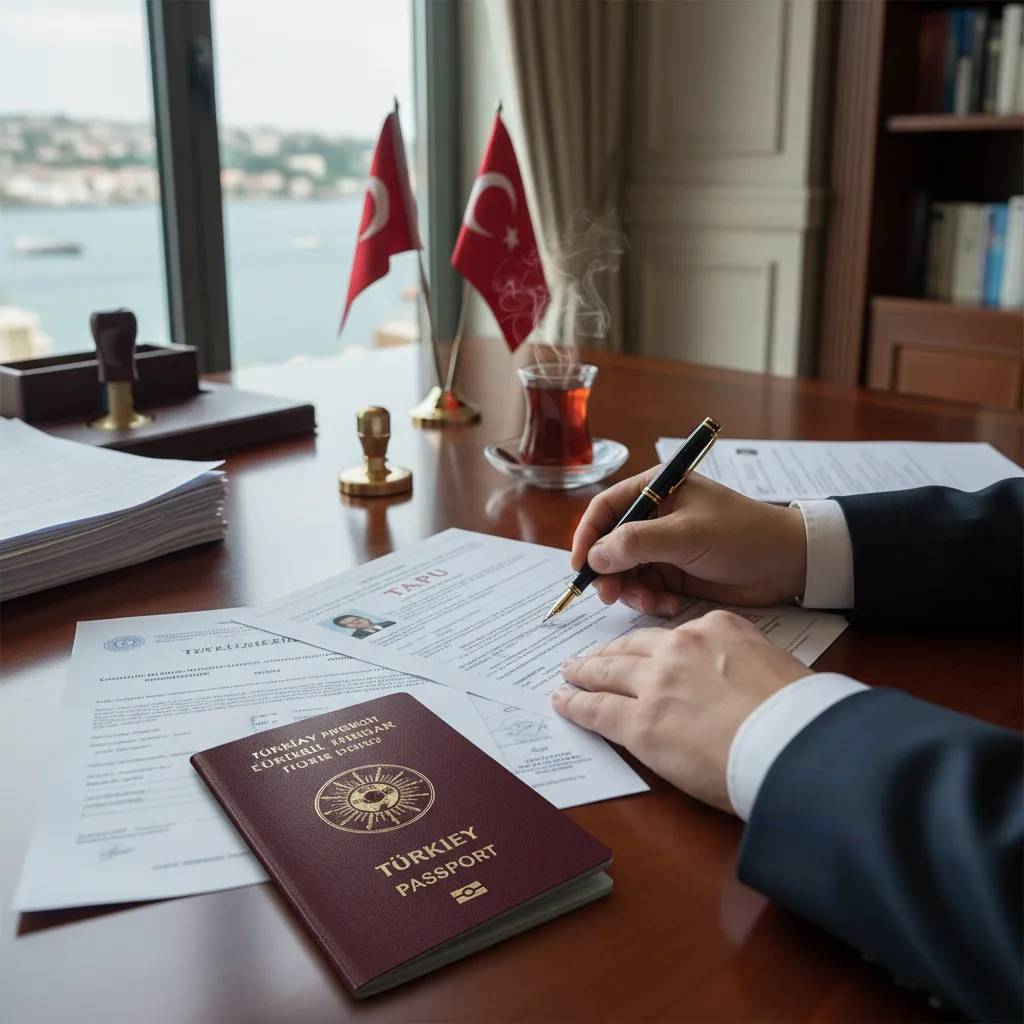
Get a free consultation now, and let us help you choose the right property.
Family Inclusion Criteria: Who Qualifies Under the Application?
The Turkish CBI framework offers generous provisions for nuclear family inclusion under a single qualifying property investment of $400,000. Understanding eligible dependent rules prevents administrative delays during document collection.
| Family Member | Eligibility Status | Required Evidentiary Documentation |
|---|---|---|
| Main Applicant (Investor) | Primary Applicant | Valid Passport, Birth Certificate, Clean Criminal Record, Proof of Funds |
| Legal Spouse | Fully Eligible | Official Marriage Certificate (Apostilled or Consular-Attested) |
| Children Under 18 | Fully Eligible | Official Birth Certificates, Parental Consent (if one parent does not apply) |
| Children Over 18 (Healthy) | Not Eligible | Must qualify independently via separate $400,000 property investment |
| Children Over 18 (Disabled) | Conditionally Eligible | Certified medical board reports demonstrating 100% parental dependency |
| Parents / In-Laws | Not Eligible | Can apply for standard touristic or humanitarian residence permits only |
Document Authentication Protocols
All civil documents issued outside Turkey (birth certificates, marriage certificates, family record books, custody decrees) must be properly authenticated to hold legal validity before Turkish courts and ministries:
- Apostille Convention Signatory Countries: Documents originating in member nations of the Hague Apostille Convention must be authenticated with a formal Apostille stamp in the country of origin.
- Non-Apostille Nations: Documents must follow a three-tier chain of legalization: origin ministry certification (e.g., Ministry of Foreign Affairs), followed by the Turkish Embassy or Consulate in that country, and final stamping by the Ministry of Foreign Affairs inside Turkey.
- Certified Translation and Notarization: Once legalized, all documents must be translated into Turkish by a certified sworn translator and notarized before a Turkish Notary Public.
Exclusions, Restrictions, and Transactional Pitfalls
Many investors mistakenly assume that any real estate listing priced above $400,000 qualifies for citizenship. Failing to identify specific legal impediments can result in complete disqualification after funds have already settled.
1. The Anti-Recycling Property Rule
To eliminate artificial sales rings designed to manufacture paper transactions, the General Directorate of Land Registry enforces strict historical checks:
- The property being acquired must not have been transferred from a foreign national to a Turkish citizen or Turkish corporate entity within the preceding three years.
- The property cannot have been involved in any prior citizenship application. Even if an investor sells the property after fulfilling their mandatory three-year holding period, the subsequent buyer cannot use that exact title deed to claim Turkish citizenship.
2. The Seller’s Nationality and Corporate Entity Structure
The seller must be a Turkish citizen by birth or a corporate entity incorporated under Turkish commercial law. If the selling company has foreign equity participation, the application faces elevated regulatory compliance checks. The property must not be purchased from companies where the foreign investor, their spouse, or their children hold shares or executive positions.
3. The 20% Foreign Ownership Neighborhood Quota
Under migration management policies introduced to prevent demographic concentration, the Ministry of Interior closed over 1,160 neighborhoods across Turkey to foreign registrations. While acquiring a title deed (Tapu) in a closed district remains legally permissible, obtaining initial investor residence permits (Article 31/j) can encounter friction if bureaucratic notifications conflict. Working with specialized legal counsel ensures that the target property is located in an unencumbered district.
4. Military and Strategic Zone Approvals
Foreign acquisitions within military exclusion zones or strategic infrastructure corridors are strictly prohibited by Law No. 2644 on Land Registry. Although Istanbul’s established urban quarters rarely encounter military denials today, coastal and rural plots must be routed through automated military clearance checks prior to final deed execution.
Financial Breakdown: Associated Acquisition Costs and Taxes in 2026
Securing Turkish citizenship involves incidental transaction costs, government levies, and administrative fees that extend beyond the baseline $400,000 real estate purchase price. Below is an exhaustive itemization of standard costs encountered during the acquisition and naturalization cycle.
| Fee / Tax Component | Statutory Rate / Approximate Cost | Responsible Party / Notes |
|---|---|---|
| Title Deed Conveyance Tax (Tapu Harcı) | 4% of declared deed value | Statutorily split 2% buyer / 2% seller; frequently negotiated in developer sales |
| Value Added Tax (KDV) | 1% to 20% (depending on property class) | Foreign non-resident buyers may qualify for full KDV exemption status |
| SPK Real Estate Valuation Report | ~$300 – $600 USD per property | Paid to designated Capital Markets Board authorized appraisal firm |
| Land Registry Circulating Capital (Döner Sermaye) | ~$250 – $450 USD | Standard administrative processing tariff paid directly to the Land Registry |
| DAB Banking Processing Fees | Varies by bank (approx. 0.1% – 0.25%) | Foreign exchange transaction costs and Central Bank handling fees |
| Translations, Notarizations & Apostilles | ~$800 – $1,500 USD per family | Dependent on page volume, family size, and country of origin |
| Residence Permit & Citizenship Government Dues | ~$400 – $800 USD per individual | Includes biometric card processing, government naturalization service fees |
| Legal Retainer Fees (Independent Counsel) | ~$5,000 – $10,000 USD | Covers Power of Attorney, due diligence, deed registration, and citizenship filings |
The KDV (VAT) Exemption Advantage
Non-resident foreign nationals buying newly developed real estate directly from construction firms can qualify for a complete exemption from Value Added Tax (KDV Muafiyeti). Standard KDV rates range between 1% and 20% depending on municipal criteria and the square meter area of the unit. Securing this exemption requires legal verification confirming that the buyer has not resided in Turkey during the preceding six months and that payments are remitted entirely in foreign currency from non-Turkish bank accounts. The property acquired under a KDV exemption cannot be sold for at least one year.
Rights, Privileges, and Post-Citizenship Obligations
Acquiring Turkish citizenship grants full civil, economic, and political rights on par with native-born Turkish citizens. However, new citizens must understand their continuing privileges and legal responsibilities.
1. The 3-Year Resale Flexibility
Unlike programs that require irreversible non-refundable donations, Turkey’s CBI model functions as an equity-preserving investment. Once the mandatory three-year holding period expires, the investor is legally free to sell the real estate on the open market, repatriate the capital, or redeploy funds into alternative global portfolios. Crucially, selling the property after the three-year mark has expired has zero impact on the investor’s retained citizenship or passport validity; Turkish citizenship is granted permanently for life.
2. Retention of Dual Citizenship
The Turkish State formally recognizes dual and multiple citizenship under Law No. 5901. Investors are not required to renounce their primary nationality, allowing them to maintain their original passport, provided their country of origin also permits dual citizenship. All family dossiers remain strictly confidential and are not shared with foreign tax authorities or international governments.
3. Military Service Obligations (Askerlik)
A frequent concern among foreign investors relates to mandatory military conscription in Turkey. Under Turkish military law, individuals who acquire citizenship via naturalization after reaching the age of 22 are permanently exempt from compulsory military service. Male minor children who acquire citizenship alongside their parents will become subject to standard conscription rules once they reach military age (typically 20 years old), unless they complete higher education deferments, pay the formal statutory exemption fee (Bedelli Askerlik), or establish completed military service in their origin country.
4. Taxation Realities for New Citizens
Turkish citizenship does not automatically trigger worldwide taxation. Turkey operates a territorial and residency-based tax regime rather than a citizenship-based tax model like the United States. New citizens only become Turkish tax residents if they maintain their legal domicile in Turkey or reside physically within the country for more than 183 days within a single calendar year. If an investor lives abroad and merely retains property inside Turkey, they are taxed strictly on their Turkish-sourced income (such as local rental yields and domestic capital gains), leaving their international wealth untaxed by the Turkish Revenue Administration.
Strategic Comparison: Istanbul vs. Secondary Turkish Real Estate Hubs
While the $400,000 statutory minimum applies nationwide, the performance of your underlying capital asset depends heavily on geographic deployment. Investors typically balance capital appreciation, rental liquidity, and lifestyle requirements across several top regions.
Istanbul: Capital Appreciation and Commercial Strength
Istanbul accounts for over 70% of all citizenship-backed real estate acquisitions. As a megacity bridging Europe and Asia, Istanbul provides unprecedented tenant demand, institutional Grade-A developments, and diverse micro-markets. Prime urban renewal zones along the central transit axes (Basın Ekspres, Kağıthane, Topkapı) offer robust exit liquidity, while affluent waterfront districts along the Bosphorus and the Marmara Sea coast command premium international resale valuations.
Antalya: High Rental Yields and Tourism Infrastructure
Antalya represents Turkey’s premier holiday resort and secondary residential destination. Supported by a thriving year-round airport network and a large foreign expatriate population, properties in areas like Konyaaltı, Lara, and Belek generate strong seasonal short-term and mid-term rental income. However, investors must be cautious of closed neighborhood zones that limit residency registrations.
Ankara and Izmir: Domestic Stability and Commercial Assets
Ankara, the nation’s political capital, and Izmir, the Aegean commercial powerhouse, present resilient domestic real estate markets less subject to foreign speculative cycles. Ankara is particularly suitable for investors targeting steady, long-term commercial leases anchored by government ministries, embassies, and academic institutions, yielding predictable cash flows denominated in domestic leases.
Essential Checklist for 2026 Citizenship Investors
To ensure a flawless path toward naturalization without legal or financial roadblocks, follow this operational checklist before deploying capital:
- Appoint an Independent Real Estate Attorney: Never rely exclusively on developer in-house legal teams. Retain an independent lawyer registered with the Turkish Bar Association (Baro) using a specific, limited Power of Attorney (Vekaletname).
- Conduct Multi-Tier Due Diligence: Verify that the property has an unencumbered title deed, zero liens, an official habitation certificate (İskan), and no historical links to prior citizenship files.
- Audit the Valuation Pre-Transfer: Confirm that the independent SPK valuation report reflects or exceeds the $400,000 baseline before initiating currency liquidation.
- Strictly Follow the DAB Flow: Ensure the transferring bank accurately enters your full name, passport identification, and citizenship purpose code into the Central Bank conversion documentation.
- Annotate the Deed at Closing: Guarantee that the 3-year resale restriction clause is formally inscribed in the registry book at the exact moment of title deed transfer.
- Prepare Legalized Family Documents Early: Secure Apostilles or consular legalizations for all family vital statistics documents (birth and marriage certificates) well in advance to avoid