
In recent years, the Turkish real estate market has become a preferred destination for investors and individuals of various nationalities, thanks to Turkey’s strategic location, diverse real estate opportunities, and the potential for lucrative investment returns. With this increasing demand for property purchases, a number of challenges and mistakes have emerged that many buyers fall into, especially those experiencing it for the first time.
Although real estate investment in Turkey is considered one of the most stable and attractive types of investments, making ill-considered decisions or neglecting certain legal and financial aspects can turn a promising opportunity into an experience full of problems and losses. Therefore, having sufficient knowledge of laws, procedures, and property verification mechanisms is an essential step before signing any contract or paying any amount of money.
In this comprehensive guide, we review the most prominent mistakes buyers make when purchasing property in Turkey, and explain how to avoid them by following the correct procedures, understanding the laws governing ownership, accurately studying costs, and choosing suitable locations for investment, thereby ensuring a safe purchasing experience and a successful long-term investment.
Lack of Full Knowledge of Real Estate Purchase Laws in Turkey
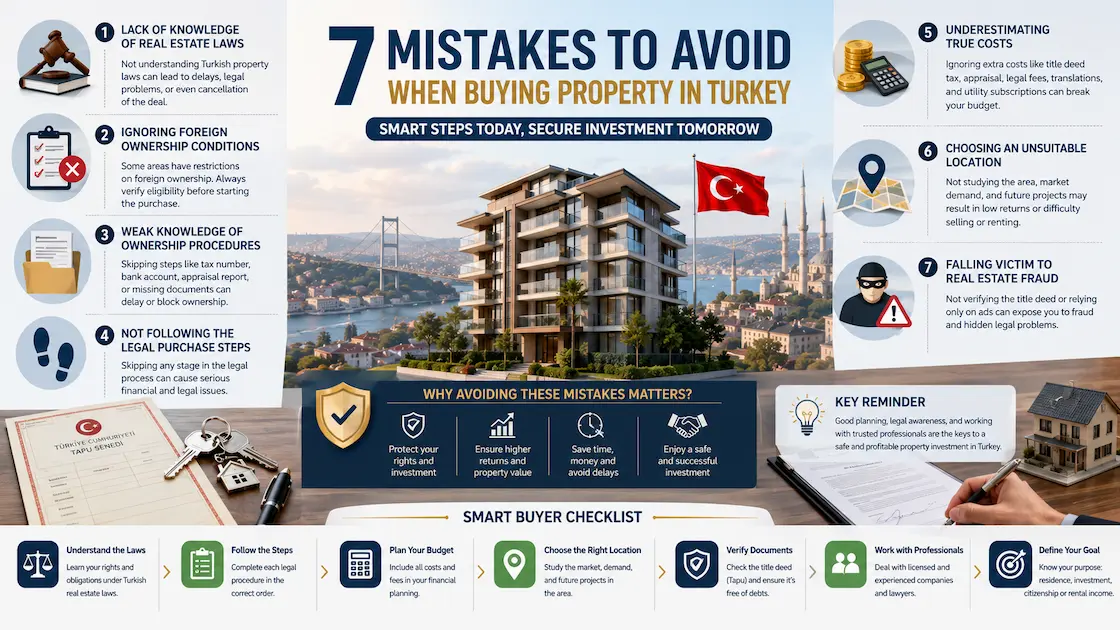
Ignorance of Turkish real estate laws and regulations is one of the biggest mistakes that can cost an investor a lot of time and money. The laws governing foreign ownership of real estate in Turkey differ from those in many other countries, and they are subject to periodic updates and regulations aimed at protecting the real estate market and ensuring its stability.
Many investors rush into buying property based on circulating information or unprofessional advice, without verifying the legal details associated with the ownership process. This can lead to legal obstacles or delays in completing the transaction, and perhaps even the cancellation of the deal entirely in some cases.
Therefore, it is essential to review the applicable legal systems and understand the rights and obligations associated with owning property in Turkey, especially for foreigners who are subject to specific conditions and procedures that vary according to nationality, type of property, and its location.
Ignoring the Conditions for Foreign Ownership of Real Estate
One of the common mistakes buyers make is not verifying the specific ownership conditions for foreigners before starting the purchase procedures. Some Turkish regions are subject to security or military restrictions that prevent foreign ownership, and there are also certain controls related to the area or number of properties in some provinces.
Some investors may be surprised after signing contracts or paying a deposit that the property they chose does not meet the necessary legal conditions for ownership, leading to unexpected complications and delays in completing the procedures.
Pre-verifying the eligibility of the property for foreign ownership saves a lot of effort and prevents falling into legal problems that may affect the future of the investment. For this reason, it is always advisable to seek the help of specialized legal entities or reliable real estate companies with extensive experience in dealing with foreign investors.
Weak Knowledge of Ownership Procedures for Foreigners
The process of purchasing property in Turkey requires completing a set of official procedures aimed at documenting the process and ensuring its legality. Among these procedures are:
- Obtaining a tax number
- Opening a bank account in a Turkish bank
- Obtaining an approved real estate appraisal report
- In addition to preparing the required official documents
Neglecting any of these steps can lead to the transaction being stalled or delayed for long periods. Some buyers also believe that the procedures are formal or optional, while in reality, they are essential requirements without which the transfer of ownership cannot be completed.
Understanding these procedures in advance helps to speed up the purchase process and avoid any bureaucratic or legal obstacles, and also gives the investor a clear vision of each stage of ownership.
Ignoring the Correct Steps for Purchasing Property
The success of a property purchase process does not depend solely on choosing the right unit, but also on adhering to the sequence of legal and administrative procedures accurately. Every step in the purchase process plays an important role in protecting the buyer’s rights and ensuring the safety of the transaction.
When some stages are bypassed or executed incorrectly, the likelihood of encountering financial or legal problems that may affect the value and future of the investment increases.
Not Following the Legal Sequence of Purchase
A successful purchase process begins with defining the purpose of the property, whether for residence, investment, or obtaining residency. This is followed by the research and comparison phase between available options, then the legal verification of the property and the validity of its documents.
Then, the official property appraisal is conducted to determine the true value of the property, before moving on to signing contracts and completing the transfer of ownership procedures at the Land Registry Office.
Neglecting any of these stages may lead to errors that are difficult to rectify later, so it is advisable not to rush and to fully adhere to all required legal steps.
Dealing with Unreliable Intermediaries
The real estate agent plays a pivotal role in the success or failure of the purchase process. Unfortunately, some buyers resort to dealing with unlicensed individuals or entities in search of cheaper offers or promises of high investment returns.
This type of dealing may open the door to fraud or the provision of inaccurate information about the property, its location, and its market value. The buyer may also find themselves facing illegal contracts or obligations they were unaware of.
Therefore, it is essential to ensure that the real estate company or agent holds the necessary licenses and has a good reputation and a reliable track record of successful transactions.
Underestimating the True Costs of Purchasing Property
Many buyers focus only on the property’s price when making a purchase decision, while ignoring a range of additional costs that are an essential part of the overall budget.
This error often leads to unexpected financial pressure after the deal is completed, especially if all fees and expenses associated with the ownership process have not been calculated.
Overlooking Additional Costs
In addition to the property price, there are multiple fees that must be taken into account, such as:
- Transfer of ownership fees
- and title deed tax
- and property appraisal fees
- and legal fees
- and translation and notarization expenses
- as well as service subscription fees
These amounts may seem small when viewed separately, but together they constitute a significant percentage of the total cost of the property. Therefore, ignoring them may cause an imbalance in financial planning and affect the expected return on investment.
Exceeding the Pre-set Budget
Some investors are attracted to properties beyond their financial capabilities due to promotional offers or marketing temptations. Although the property may seem like a unique opportunity, exceeding the budget can lead to long-term financial burdens.
Setting a clear financial plan before starting the property search helps to define realistic purchase limits, and also prevents making emotional decisions that may affect the investor’s financial stability.
Choosing an Unsuitable Location for Investment
Location is one of the most important factors determining the success of real estate investment and its future value. A distinguished property in a promising area may achieve high returns and continuous growth in value, while a property in a weak location may suffer from difficulty in renting or reselling.
Failure to Carefully Study Investment Areas
Turkey includes many cities and regions that differ in terms of demand level, investment return, and future growth opportunities. Therefore, choosing the appropriate area must be based on a realistic market study and not just on personal impressions.
Istanbul is one of the most prominent investment destinations due to its population density and major development projects, while Antalya is characterized by the strength of its tourism sector, and Bursa offers attractive investment opportunities at more competitive prices.
Failure to study these factors may lead to purchasing a property in a limited growth area, which reduces the chances of achieving the desired profits.
Neglecting Local Market Analysis
Understanding the supply and demand dynamics in the target area helps the investor make more accurate decisions. Monitoring new government projects and infrastructure plans also provides important indicators about the real estate future of the area.
When these indicators are ignored, the purchase decision becomes based on speculation rather than factual data, which increases the likelihood of losses or a decrease in investment returns.
Falling Victim to Real Estate Fraud
With the increasing demand for Turkish properties, some fraudulent practices have emerged targeting investors unfamiliar with market details. Therefore, caution and thorough verification of all documents and procedures are indispensable.
Failure to Verify the Validity of the Title Deed
The title deed or “Tapu” is the most important document in any real estate purchase process. It is essential to verify the accuracy of the data contained therein, and to check for any debts, mortgages, or legal encumbrances registered on the property.
Neglecting this step may lead to purchasing a property facing complex legal problems, and the buyer may find themselves forced to bear financial obligations they were unaware of.
Relying Solely on Marketing Advertisements
Professional photos and enticing offers may not reflect the true reality of the property. Therefore, making a purchase decision based solely on advertisements is one of the common mistakes many investors fall into.
Visiting the property in person, or sending a trusted party to inspect it, and ensuring that the advertised specifications match reality, are all necessary steps to ensure a decision based on accurate information.
Poor Investment Planning
Even the best properties may not achieve the desired results if purchased without a clear strategy. Planning is the element that connects the investment goal with selecting the right property and achieving the desired return.
Successful investment requires market study, risk analysis, evaluation of expected returns, and understanding future growth trends. When these fundamentals are ignored, the investment decision becomes closer to an adventure than a well-thought-out investment.
Relying on accurate information and specialized consultations helps evaluate opportunities professionally and reduces the likelihood of making wrong decisions.
Failure to Define the Purpose of Purchasing the Property
One of the most common mistakes affecting the quality of a real estate decision is the absence of a clear purpose for the purchase. A property suitable for living may not be the best option for investment, and a property that generates high rental income may not suit someone looking for permanent residency.
Therefore, the goal must be defined from the outset, whether it is to generate rental income, achieve future profits from resale, residential stability, or benefit from residency and citizenship programs. This clarity helps in choosing the most suitable property and avoiding many costly mistakes.
A Brief Table of Key Mistakes and Their Solutions
| Mistake | Potential Outcome | Solution |
|---|---|---|
| Ignoring real estate laws | Delay or refusal of ownership | Understanding laws and seeking legal experts |
| Not following purchase steps | Financial losses and legal problems | Adhering to all official procedures |
| Underestimating costs | Unexpected financial pressure | Preparing a comprehensive budget that includes all fees |
| Choosing an unsuitable location | Poor investment return | Thoroughly studying areas and the local market |
| Dealing with untrustworthy parties | Exposure to fraud | Choosing licensed companies and brokers |
| Not verifying the title deed | Legal problems with the property | Carefully reviewing the title deed |
| Absence of investment planning | Uninformed decisions | Defining the goal and developing a clear strategy |
Conclusion
Purchasing property in Turkey can be a successful and profitable investment step if handled in a well-thought-out and conscious manner. Legal knowledge, adherence to correct procedures, studying real costs, and choosing the right location are all essential elements that contribute to protecting the investor and enhancing their chances of success.
Moreover, verifying all real estate documents and dealing with trustworthy parties significantly reduces the risks of fraud and legal problems. Ultimately, good planning and making decisions based on accurate information remain the true key to transforming property purchase in Turkey into a safe and sustainable investment that achieves desired long-term goals.