
Turkey, a transcontinental nation bridging Europe and Asia, has rapidly emerged as a global hub for tourism, business, and real estate investment. With its rich cultural heritage, robust infrastructure, and strategic geographical location, thousands of foreign nationals seek to establish a legal status in the country every year. Whether you are planning a temporary vacation, seeking a long-term residency, or aiming to acquire full citizenship, navigating the legal framework can be complex.
Understanding the precise requirements for Turkish legal status is crucial to ensuring a smooth, successful application process. This comprehensive guide provides an exhaustive, step-by-step breakdown of the requirements for Turkish visas, residency permits (Ikamet), and citizenship pathways. Backed by the latest regulatory updates, this article serves as your definitive roadmap to securing your future in Turkey.

1. Comprehensive Requirements for Turkish Citizenship
Acquiring Turkish citizenship is the ultimate goal for many expatriates and investors. Turkey offers several pathways to citizenship, regulated primarily by the Turkish Citizenship Law No. 5901. Below, we analyze the specific requirements for each major pathway, including investment, naturalization, marriage, and descent.
Turkish Citizenship by Investment (CIP)
Launched in 2017 and updated periodically, the Turkish Citizenship by Investment Program is one of the most popular and efficient programs of its kind globally. It allows foreign investors to obtain a Turkish passport within a few months. There are several investment routes available, each with its own set of stringent requirements.
The Real Estate Acquisition Route ($400,000 Minimum)
The most popular pathway to citizenship is through property acquisition. To meet the requirements for Turkish citizenship via real estate, you must fulfill the following conditions:
- Minimum Investment Value: You must purchase real estate with a minimum value of $400,000 USD. This value is calculated based on the official valuation report and the foreign exchange purchase certificate (Döviz Alım Belgesi).
- Three-Year Holding Period: You must place an annotation on the title deed (Tapu) promising not to sell the property for at least three years from the date of purchase.
- Official Valuation Report: A valuation report must be prepared by an authorized appraisal company licensed by the Capital Markets Board of Turkey (SPK). The report must confirm the property’s value is at least $400,000 and must be issued within three months of the transaction.
- Foreign Exchange Transaction: All transaction funds must be transferred in foreign currency to the Central Bank of Turkey (TCMB) through a Turkish intermediary bank prior to the title deed transfer. The bank will issue a Foreign Exchange Purchase Certificate (Döviz Alım Belgesi), which is a mandatory document for the application.
- Certificate of Conformity: The Ministry of Environment, Urbanization, and Climate Change must issue a Certificate of Conformity confirming that the investment meets all legal criteria.
The Capital Investment and Bank Deposit Routes ($500,000 Minimum)
For those who prefer financial investments over real estate, alternative routes exist under the following requirements:
- Bank Deposit: Deposit a minimum of $500,000 USD (or equivalent foreign currency) into a Turkish bank operating in Turkey. The funds must be held in the account for at least three years, and the investment must be verified by the Banking Regulation and Supervision Agency (BDDK).
- Fixed Capital Investment: Make a minimum fixed capital investment of $500,000 USD, verified by the Ministry of Industry and Technology. This can include setting up a business, purchasing shares in a Turkish company, or investing in manufacturing facilities.
- Government Bonds: Purchase at least $500,000 USD worth of government debt instruments or bonds, with a commitment to hold them for three years. This route must be verified by the Ministry of Treasury and Finance.
- Venture Capital or Real Estate Investment Funds: Purchase at least $500,000 USD worth of real estate investment fund shares or venture capital investment fund shares, held for three years and verified by the Capital Markets Board.
The Job Creation Route (50 Employees)
If you are an entrepreneur, you can satisfy the requirements for Turkish citizenship by establishing a business that employs at least 50 Turkish citizens. This employment must be continuous, compliant with Turkish labor laws, and verified by the Ministry of Labor and Social Security.
Turkish Citizenship by Naturalization (General Pathway)
For foreigners who reside in Turkey long-term without making a major financial investment, naturalization is the standard route. The statutory requirements for Turkish naturalization are highly rigorous:
- Continuous Residency: You must have resided in Turkey legally and continuously for at least five years immediately preceding your application. You are allowed to spend no more than a total of 360 days outside Turkey during this five-year period.
- Intent to Settle: You must demonstrate a clear intention to settle in Turkey. This can be proven by purchasing property, establishing a business, marrying a Turkish citizen, or having children study in Turkey.
- Language Proficiency: You must possess a sufficient level of Turkish language skills to communicate effectively in daily life. This is typically assessed during an interview conducted by the local Citizenship Commission.
- Financial Independence: You must prove that you have a stable, sufficient income or profession to support yourself and any dependents in Turkey without relying on social assistance.
- Good Moral Character and Health: You must not have a criminal record that poses a threat to national security or public order. Additionally, you must obtain a medical report from an authorized state hospital confirming that you do not carry any disease that poses a threat to public health.
Turkish Citizenship by Marriage
Marrying a Turkish citizen does not grant automatic citizenship, but it does fast-track the process. The requirements for Turkish citizenship through marriage include:
- Duration of Marriage: You must be legally married to a Turkish citizen for at least three consecutive years.
- Family Unity: The spouses must live together in a genuine family union. The authorities will conduct home visits and interviews to verify that the marriage is genuine and not a marriage of convenience.
- Security and Public Order: The foreign spouse must not engage in any activities incompatible with the marital union and must not pose any threat to national security or public safety.
Turkish Citizenship by Descent (Lineage)
Turkey adheres to the principle of *jus sanguinis* (right of blood). If you have Turkish ancestry, you may be eligible for citizenship by descent. The requirements for Turkish citizenship through lineage include:
- Parental Connection: At least one of your parents must have been a Turkish citizen at the time of your birth, regardless of whether you were born in Turkey or abroad.
- Documentary Proof: You must present certified, apostilled birth certificates, marriage certificates, and official population registry documents (*vukuatlı nüfus kayıt örneği*) tracing your family lineage back to a Turkish ancestor.
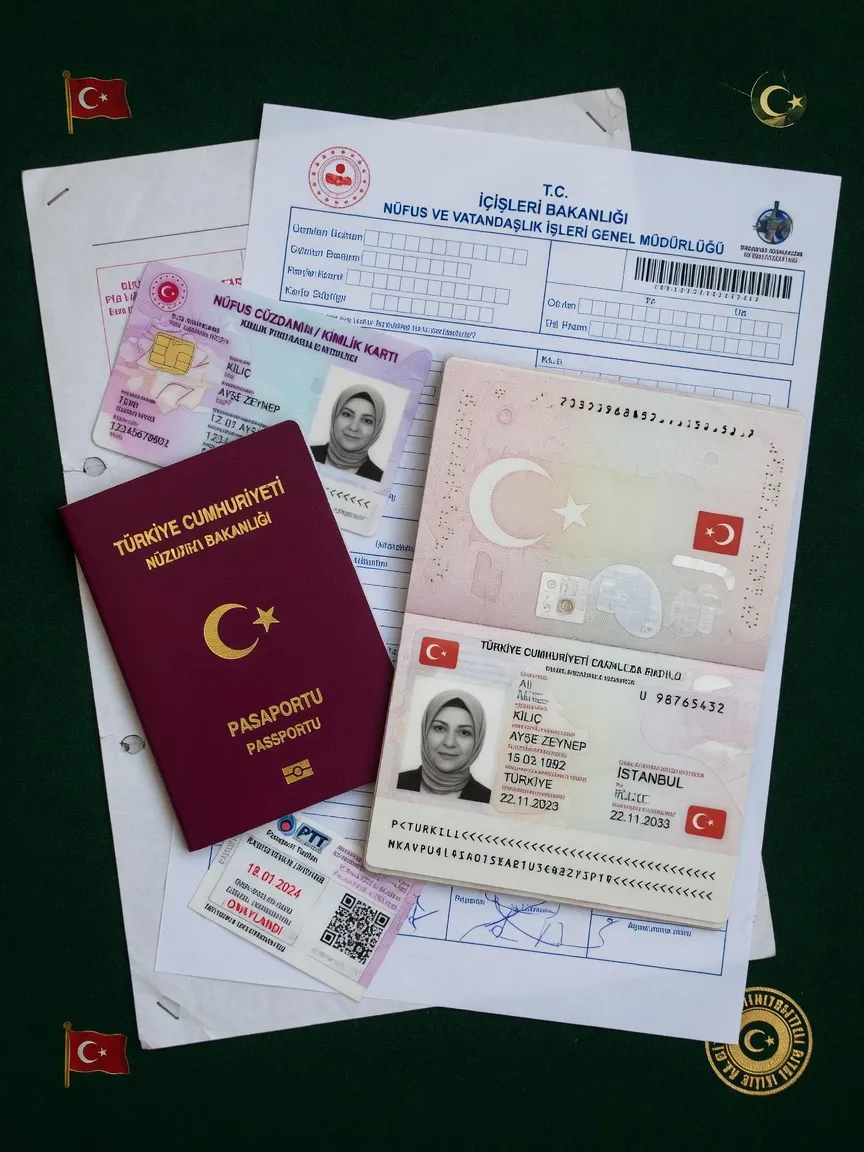
2. Requirements for Turkish Residency Permits (Ikamet)
If you plan to stay in Turkey for longer than the duration of a tourist visa (usually 90 days within a 180-day period) but are not yet ready or eligible for citizenship, you must apply for a Residence Permit (*İkamet Tezkeresi*). The requirements for Turkish residency vary depending on the type of permit you seek.
Short-Term Residence Permit (Touristic and Real Estate)
The short-term residence permit is the most common entry point for expats. It is typically granted for one to two years.
Real Estate Ownership Residency (New $200,000 Threshold)
According to recent regulatory updates implemented by the Presidency of Migration Management (Göç İdaresi), foreign nationals who wish to obtain or renew a residence permit through property ownership must meet stricter financial requirements:
- Property Value: The property purchased must have a minimum value of $200,000 USD (based on the valuation and transaction records) across all cities in Turkey. This is a significant increase from previous years, designed to regulate the housing market.
- Residential Use: The property must be residential and used primarily for the applicant’s accommodation.
Touristic Residence Permit
Historically, many foreigners obtained residency simply by submitting a tourist rental agreement. However, Turkey has significantly tightened the requirements for Turkish touristic residence permits:
- Detailed Travel Plan: Applicants must submit a comprehensive travel itinerary, including hotel bookings, flight tickets, and a written explanation of their touristic goals.
- Financial Sufficiency: You must prove you have sufficient financial means to support your stay. The general standard is showing a bank statement with funds equivalent to at least the Turkish minimum wage for each month of the requested permit duration.
- Valid Rental Agreement: If renting, the lease contract must be notarized, and the landlord must provide their identity details and title deed copy. In many districts, a notary must witness the landlord signing the contract.
Student Residence Permit
Foreign students enrolled in Turkish higher education institutions, high schools, or authorized language courses can apply for a student residency. The key requirements include:
- Active Enrollment Certificate: A student certificate (*Öğrenci Belgesi*) issued by the university or school registered with the Council of Higher Education (YÖK).
- Financial Support: Proof of financial capability to cover tuition fees and living expenses.
- Valid Health Insurance: Students must obtain either private health insurance or register with the state Social Security Institution (SGK) within three months of enrollment.
Family Residence Permit
A family residence permit can be granted to the foreign spouse, minor children, or dependent foreign children of a sponsor (who must be a Turkish citizen or a legal resident holding a valid work or residence permit). The sponsor must meet the following requirements:
- Income: The sponsor’s monthly income must not be less than the total minimum wage, with at least one-third of the minimum wage allocated per family member.
- Appropriate Housing: The sponsor must provide accommodation that meets general health and safety standards, suitable for the family’s size.
- Health Insurance: The sponsor must provide valid medical insurance covering all family members.
- No Domestic Crimes: The sponsor must submit a clean criminal record showing no convictions for domestic violence or family-related crimes within the last five years.
Long-Term Residence Permit
Foreigners who have resided in Turkey continuously for at least eight years under a valid residence permit can apply for a prestigious long-term residence permit, which does not require renewal. The requirements for Turkish long-term residency are:
- Continuous 8-Year Residence: No long gaps in residency. Days spent on student permits are calculated at half-value (e.g., 4 years of student residency equals 2 years toward the 8-year requirement).
- No Social Assistance: The applicant must not have received any financial assistance or social aid from government institutions or NGOs within the last three years.
- Sufficient and Regular Income: Reliable proof of steady income to support oneself and family members.
- Private or Public Health Insurance: A valid health insurance policy covering the entire duration of the stay.
- Public Security: The applicant must not pose a threat to public order or national security.
3. Requirements for Turkish Visas and Entry
Before you can apply for residency or citizenship, you must legally enter the country. Turkey offers various visa categories depending on the purpose of your travel, including tourism, business, education, and employment.
Tourist Visas and the E-Visa System
Citizens of many countries are eligible for visa-free entry or can easily obtain an electronic visa (e-Visa) online. For those who must apply for a traditional sticker visa at a Turkish embassy or consulate, the general requirements for Turkish tourist visas include:
- Passport Validity: Your passport must be valid for at least 60 days beyond the duration of your visa, visa exemption, or residence permit. It must also have at least one blank page.
- Biometric Photos: Two recent biometric photos (5×6 cm) with a white background.
- Proof of Accommodation and Travel: Confirmed round-trip flight tickets and hotel reservations.
- Financial Independence: Bank statements showing sufficient funds (typically $50 USD per day of stay in Turkey).
- Travel Health Insurance: A policy that covers medical evacuation and repatriation, valid for the entire duration of your stay.
Work Visa and Work Permit Requirements
Working legally in Turkey requires a combined Work Permit and Work Visa. The application is a dual process involving both the employee and the Turkish employer, regulated by the Ministry of Labor and Social Security (CSGB).
Employer Requirements
To hire a foreign national, a Turkish company must satisfy several operational and financial benchmarks:
- The 5:1 Employment Ratio: The employer must employ at least five Turkish citizens for every one foreign worker they hire. If the foreigner is a shareholder in the company, this ratio is applied only for the last six months of the one-year work permit.
- Paid-In Capital: The company’s paid-in capital must be at least 100,000 TRY, or its gross sales must be at least 800,000 TRY, or its export volume must be at least $250,000 USD in the previous year.
- Fair Salary: The wage offered to the foreign employee must be proportional to their role and must meet the minimum wage multipliers set by the Ministry (e.g., engineers, pilots, and senior managers require higher wage ratios).
Employee Requirements
The foreign worker must submit several documents to support the application:
- Employment Contract: A signed bilateral employment contract outlining the job description, salary, and terms.
- Diploma Equivalency: For specialized professions (such as engineering, architecture, or medicine), the employee’s university diploma must be translated, notarized, and approved for equivalency (Denklik) by the Council of Higher Education (YÖK).
- Valid Visa or Residence Permit: If applying from within Turkey, the applicant must hold a valid residence permit with at least six months of remaining validity. If applying from abroad, the application must be initiated at a Turkish consulate in the applicant’s home country.
4. Essential Bureaucracy: Documentation, Legalization, and Fees
Fulfilling the legal requirements for Turkish citizenship, residency, or visas involves navigating a highly structured bureaucratic process. Missing a single stamp or failing to legalize a document can lead to immediate rejection. Below is an overview of the essential administrative steps you must take.
The Apostille and Notarization Process
Any document issued outside of Turkey (such as birth certificates, marriage certificates, diplomas, and power of attorney documents) must be legally validated before it can be accepted by Turkish authorities.
- Apostille Convention: If your home country is a member of the Hague Apostille Convention, you must obtain an Apostille stamp on your original documents from the designated authority in your home country.
- Consular Legalization: If your country is not a member of the Hague Convention, your documents must be legalized by your country’s Ministry of Foreign Affairs and then authenticated by the Turkish Embassy or Consulate in that country.
- Notarized Translation: Once the apostilled/legalized documents arrive in Turkey, they must be translated into Turkish by a certified sworn translator (*Yeminli Tercüman*) and officially notarized by a Turkish Notary Public (*Noter*).
Obtaining a Turkish Tax Number (Vergi Numarası)
A Turkish Tax Identification Number (TIN) is a fundamental prerequisite for almost all legal transactions in Turkey, including opening a bank account, buying property, paying residence permit fees, and registering a vehicle. Fortunately, obtaining a tax number is simple and can be done online through the Interactive Tax Office website (*İnteraktif Vergi Dairesi*) or in person at any local tax office by presenting your original passport and a copy.
Opening a Turkish Bank Account
To satisfy the financial requirements for Turkish citizenship or residency, you will need to open a local bank account. Turkish banks are highly modern, but they have strict compliance procedures. To open an account, you will typically need to present:
- Your original passport and a copy.
- Your Turkish Tax Number.
- Proof of address: This can be a utility bill (electricity, water, or gas) from your home country or Turkey, or an official rental contract. The bill must clearly show your name and residential address.
- A local Turkish SIM card (required for mobile banking setup and receiving verification codes).
Health Insurance Requirements
Having valid health insurance is a non-negotiable requirement for all residence permit applicants under the age of 65 (and optional but recommended for those older). There are two main options:
- Private Foreigner Health Insurance: This is the most popular and affordable option for short-term residency. These policies are specifically designed to meet the minimum coverage requirements set by the Migration Management, covering outpatient and inpatient treatments up to specific limits.
- SGK (State Social Security): Foreigners who have legally resided in Turkey for at least one year can opt into the government-run SGK system. By paying a monthly premium, the applicant and their direct dependents receive full medical coverage at state hospitals and significant discounts at private hospitals.
5. Detailed Comparison of Key Pathways
To help you visual the differences, the table below summarizes the key requirements for Turkish citizenship, residency, and work permits.
| Path/Permit Type | Key Financial Requirement | Minimum Duration/Holding Period | Primary Target Audience |
|---|---|---|---|
| Citizenship by Real Estate | $400,000 USD property purchase | 3-year holding period | High-net-worth investors, families |
| Citizenship by Naturalization | Stable income, self-sufficiency | 5 years continuous residency | Long-term expats, remote workers |
| Real Estate Residency | $200,000 USD property purchase | Renewable annually/biennially | Property owners, retirees |
| Touristic Residency | Proof of sufficient funds (min. wage monthly) | 1 to 2 years maximum | Extended tourists, slow travelers |
| Work Permit | Salary meeting Ministry guidelines | Tied to employment contract | Professionals, company employees |
6. Common Pitfalls and How to Avoid Them
Even with clear guidelines, many applicants face delays or rejections due to avoidable mistakes. Being aware of these common pitfalls can save you time, money, and stress.
1. Incomplete Address Registration (UAVT System)
Turkey relies heavily on the Address Registration System (AKS). When applying for residency, your address must be registered in the national database. If your rental property or purchased home is not properly registered under the National Address Database (UAVT), or if another person is still registered as living at your address, your residency application will be put on hold or rejected. Always verify the address status at the local population registry office (*Nüfus Müdürlüğü*) before your appointment.
2. Discrepancies in Property Valuation Reports
For citizenship or real estate residency, the valuation report must match or exceed the required thresholds ($400,000 for citizenship, $200,000 for residency). Some buyers rely on the seller’s word or real estate agents who inflate prices. Always hire an independent, SPK-licensed appraiser to ensure the official valuation matches the actual transaction price paid through bank transfers.
3. Falling Short of the 180-Day Rule
For those aiming for citizenship by naturalization, keeping track of time spent outside Turkey is vital. Exceeding the 360-day limit outside the country within the 5-year qualifying period resets your residency clock, forcing you to start the 5-year count all over again. Keep a meticulous log of your entry and exit stamps.
4. Failing to Convert Foreign Currency Properly
Under the Central Bank’s rules, foreign currency for property purchases intended for citizenship must be sold to the Central Bank of Turkey through a local bank *before* the title deed transfer. Direct bank transfers in USD or Euros to the seller’s account no longer satisfy the legal requirements. You must obtain the Foreign Exchange Purchase Certificate (*Döviz Alım Belgesi*), which explicitly states that the currency was sold to the Central Bank for the purpose of purchasing property.
Conclusion: Navigating Your Journey to Turkey
Meeting the requirements for Turkish citizenship, residency, or visa status is a structured but highly rewarding process. Turkey offers an unparalleled lifestyle, dynamic business opportunities, and a welcoming environment for global citizens. Whether you are investing in Istanbul’s booming real estate market, enrolling in a prestigious university, or planning an extended stay along the scenic Aegean coast, preparation is key.
By ensuring your documents are properly legalized, understanding the financial thresholds, and staying updated on the latest legislative changes, you can confidently navigate the bureaucratic landscape. For complex cases—especially those involving high-value investments or citizenship applications—consulting with a qualified Turkish immigration attorney or licensed real estate consultant is highly recommended to guarantee a seamless transition to your new life in Turkey.